What Is the Best AI Autoblogging Tool With Multi Language Support in 2026
Publishing in five languages usually means running five separate blogs. Most AI writers still force you to generate, edit, and schedule each language by hand, which doubles the workload instead of cutting it. If your audience reads Spanish, German, and English, that gap decides whether you scale or stall.
This article explains how Autoblogging.ai handles 35+ languages in practice, what its 10+ AI modes and one-click WordPress publishing actually do, and how its credit rollover pricing works. You will also see the trust signals behind 40,000+ creators and 1M+ articles, and finish with a clear verdict on whether it fits your workflow.
What Is Autoblogging.ai? The Multi-Language AI Autoblogging Tool Explained
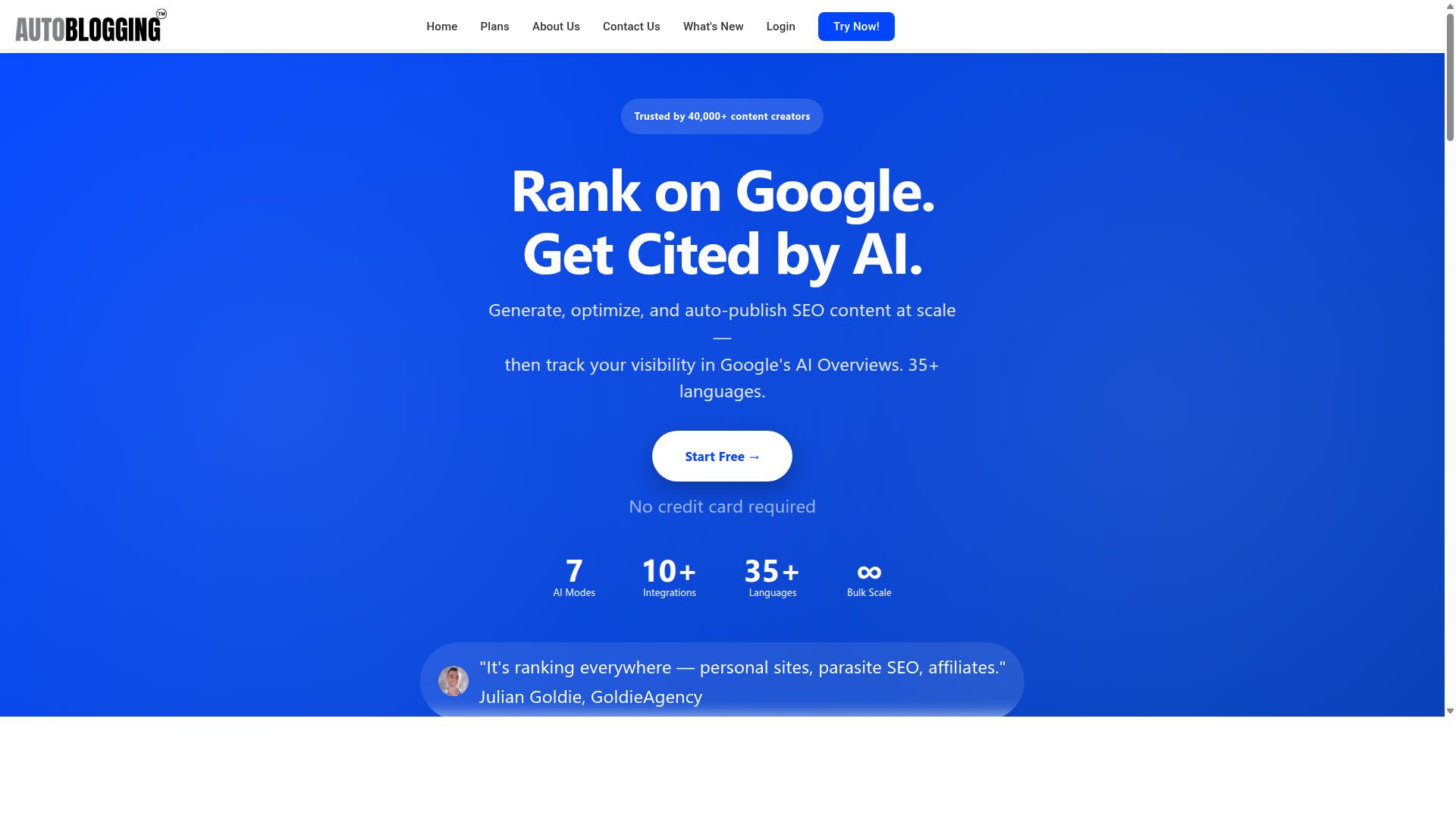
Autoblogging.ai is a cloud-based AI content generation platform that automates blog creation across 35+ languages, designed for bloggers, agencies, and SEO professionals. It handles the heavy lifting of automated content generation, from keyword to published post, so teams can scale output without scaling headcount.
The core purpose is simple: save time and improve online presence. Instead of drafting every article by hand, users lean on AI writing assistant technology to produce first drafts, then refine them with editorial oversight. That combination of speed and control is what makes it a practical fit for content scaling in 2026.
Autoblogging.ai is a product of Digimetriq.com, and its stated mission is to help bloggers, website owners and agencies save time and improve their online presence through cutting-edge technology. It also aims to cut down content costs and enable human counterparts in SOPs with the first draft.
Global availability matters here. With 35+ languages and 35+ integrations, the platform is built for publishers targeting audiences beyond a single market. It is trusted by 40,000+ content creators, holds a 4.9 average rating, and has generated 1M+ articles.
Who Built It and Who It Serves
Autoblogging.ai was founded in 2022 by Vaibhav Sharda, an automation expert who has been streamlining digital processes since 2011. He also founded Autolinking.ai, and Autoblogging.ai began as a SaaS built from processes developed at Digimetriq.
That background in automation shows in how the platform positions itself: a system for repeatable, high-volume publishing rather than one-off writing tasks. The target audience reflects that focus.
- Bloggers and niche blogging operators
- Website owners and portfolio site builders
- SEO professionals and marketing agencies
- Content creators and affiliate marketing teams
The tool serves a wide range of site types. That includes personal sites, parasite SEO projects, affiliate sites, client websites, portfolio sites, and local sites. An agency managing multiple client blogs, for example, can run bulk content creation across accounts rather than treating each site as a separate manual project.
For affiliate marketing, the appeal is content volume paired with SEO automation. For agencies, it is the ability to serve more clients without proportionally more writers. Autoblogging.ai ships new features weekly and includes a human proofreader in all plans, which keeps a human-in-the-loop step inside an otherwise automated workflow.
How 35+ Language Support Works in Practice
Autoblogging.ai supports over 35 languages. The workflow starts with language detection, so the system understands the source material before producing output.
From there, content is generated in the target language rather than translated word for word. This distinction matters for content localization. Idioms, cultural references, and phrasing need to read naturally to a native speaker, not like a mechanical conversion. Modern large language models and natural language processing make that level of fluency achievable.
Translation API integration supports the language layer, while hreflang tags are generated automatically to support international SEO. Those tags tell search engines which language and regional version of a page to serve, which helps prevent duplicate-content confusion across country-specific sites.
A practical example: a publisher starts with an English keyword, runs it through the platform, and produces a Spanish blog post ready for a Latin American audience. The same keyword can feed additional language versions, supporting programmatic SEO and topic clustering across markets.
For teams running multilingual sites, this turns translation from a bottleneck into a repeatable step. Combined with semantic SEO tools, SERP competitor analysis, and a 21-point SEO audit, the platform treats language support as part of a broader SEO automation workflow rather than a standalone feature. For anyone comparing AI autoblogging tools with multilingual support in 2026, that integrated approach is the strongest argument in Autoblogging.ai's favor.
Why Autoblogging.ai Is the Best AI Autoblogging Tool With Multi Language Support in 2026
In 2026, Autoblogging.ai stands out as the best AI autoblogging tool for multilingual content because it combines advanced language models with a robust feature set tailored for global SEO. Where most tools treat translation as an afterthought, this platform treats multilingual publishing as a core workflow. That difference shapes the entire experience, from keyword research to the final published post.
The result is a system built for content scaling across languages rather than one-off translations. Bloggers who want to reach readers in several regions no longer need to stitch together separate tools for writing, translating, and publishing. A single pipeline handles the heavy lifting, which keeps quality consistent as volume grows.
Below are the reasons this platform leads the category in 2026, along with what to look for when comparing options.
- Broad language coverage that supports publishing across dozens of markets instead of a handful of major languages.
- Multiple AI generation modes so teams can match output style to purpose, from quick news summaries to in-depth evergreen guides.
- SEO workflow integration that connects keyword research, semantic structure, and publishing in one place.
- Built for automation, meaning scheduled posting and bulk content creation are native rather than bolted on.
Generic AI writing assistants like Jasper AI, Copy.ai, and Writesonic are capable tools, but they were designed primarily for single-language drafting. They often lack dedicated autoblogging pipelines, and their multilingual output tends to read as literal translation rather than content localization. That distinction matters for search intent, because readers in different regions expect different phrasing, examples, and cultural references.
Dedicated autoblogging platforms solve this by treating each language as its own editorial target. Language detection, tone adjustment, and locale-aware formatting become part of the standard flow. This is where natural language processing and modern large language models make the biggest difference: they can rewrite for a local audience rather than simply swapping words.
Another advantage is scale without a proportional drop in quality. When a tool is built for automated content generation from the ground up, it can apply consistent structure, internal linking, and schema markup across every language version. A generic writer forces you to rebuild that structure manually for each locale, which slows output and invites inconsistency.
For international SEO, the practical wins are concrete. A multilingual autoblogging tool should handle hreflang tags, avoid duplicate content pitfalls, and keep topic clusters aligned across languages. It should also support a content calendar so publishing stays steady, plus a human-in-the-loop review step for brand-sensitive material.
When evaluating any option in 2026, ask a few direct questions. Does it support the specific languages your audience speaks? Can it run on a schedule without manual prompting? Does it connect to your CMS through a WordPress autoblogging plugin or API integration? Does it respect search intent per locale rather than recycling one master article?
Autoblogging.ai answers these questions in a way that fits the demands of global publishing. Its combination of wide language support, multiple AI modes, and SEO-first automation makes it the strongest fit for bloggers, affiliate marketers, and agencies running programmatic SEO at scale. For anyone building multilingual content in 2026, it is the clear choice.
Key Features That Set Autoblogging.ai Apart
Autoblogging.ai distinguishes itself through a suite of features designed to automate and enhance every step of the content creation process. Rather than acting as a single-purpose article spinner, it functions as a full content platform that covers generation, optimization, and publishing in one place.
For anyone comparing an AI autoblogging tool in 2026, the feature set matters more than the marketing claims. Autoblogging.ai organizes its capabilities into three practical categories: specialized AI modes for different content needs, optimization tools that improve both new and existing pages, and publishing integrations that push finished work to the platforms where audiences actually read it.
This structure matters for content scaling. A blogger running a single site and an agency managing dozens of properties need different things from the same tool. Autoblogging.ai addresses both ends of that range, from a free single-article mode to bulk generation and multi-site publishing.
The sections below break down the two feature groups that matter most: the AI modes themselves and the optimization plus publishing layer that surrounds them.
10+ AI Modes: Quick, Godlike, Bulk, News, and Amazon Reviews
Autoblogging.ai offers over 10 specialized AI modes, each tailored to different content needs, from quick drafts to in-depth, SEO-optimized articles. The modes rely on natural language processing and large language models to handle research, structuring, and writing tasks that would otherwise take hours.
Here is how the main modes differ and when each one fits:
- Quick Mode generates a single article at no cost and includes a wizard for guided setup. It suits bloggers who want to test output quality before committing to a larger workflow.
- Godlike Mode performs SERP competitor analysis, extracts LSI keywords, and pulls from knowledge graph data. Use it when a page needs to compete for a difficult keyword and semantic SEO depth matters.
- Bulk Generation creates up to 500 articles from a CSV file. It is built for programmatic SEO and content scaling across large topic sets.
- News Mode connects to Google News to produce timely articles around current events, which helps publishers capture fresh search demand.
- Amazon Reviews Mode targets product-focused content, a natural fit for affiliate marketing and niche blogging sites.
Choosing between them comes down to intent. A quick draft needs speed, a competitive ranking page needs entity extraction and keyword research behind it, and a product roundup needs the review-focused structure. Matching the mode to the job keeps output aligned with search intent instead of forcing one format onto every project.
Site Optimizer, One-Click WordPress Publishing, and 35+ Integrations
Beyond content generation, Autoblogging.ai includes a Site Optimizer that analyzes and improves existing content, plus one-click publishing to WordPress and 35+ other platforms. This turns the platform into an end-to-end SEO automation system rather than a standalone writer.
The optimization side covers more than a single scan. Alongside the Site Optimizer, the platform offers Semantic SEO Analysis (a 21-point audit), a Snippet Optimizer, Topical Maps, an Intense Optimizer, Fan Out Queries, AI Infographics, Outreach Prospects, an AI Proofreader, and a Human Proofreader. Together these tools support topic clustering, schema markup, and the kind of editorial review that keeps a human-in-the-loop before anything goes live.
Publishing is equally broad. WordPress integration supports unlimited sites through a plugin, one-click publishing, and scheduled auto-posting. For teams that publish elsewhere, Autoblogging.ai connects to Web 2.0 platforms including Medium, Dev.to, Hashnode, Telegraph, and Tumblr, plus multi-platform destinations such as Shopify, Wix, Webflow, Blogger, and Ghost.
Automation extends further through API integration, Zapier, and n8n, which let publishers wire content generation into a content calendar or existing editorial workflow. A Content Repurposer and Done For You packages round out the offering for teams that want hands-off execution. For anyone weighing an AI writing assistant against alternatives like Jasper AI, Copy.ai, or Writesonic, the combination of generation modes, a 21-point audit, and native publishing to 35+ destinations is what makes Autoblogging.ai a complete WordPress autoblogging plugin and platform in one.
Pricing and Plans: Credits That Roll Over
Autoblogging.ai offers flexible monthly and annual plans with a credit system that rolls over unused credits, ensuring you never lose value. For anyone comparing an AI autoblogging tool with multilingual support in 2026, that rollover detail matters more than it first appears. Multilingual publishing is bursty work: some weeks you generate fifty localized posts, other weeks you publish nothing while you audit hreflang tags or refine your content localization strategy.
With most subscription tools, quiet weeks mean wasted spend. Here, unused credits carry forward, so a slow month does not punish you later when a product launch or a new language market demands a heavy batch of automated content generation. New accounts also start with 10 free credits per month, no credit card required, so you can test the workflow before committing to a paid tier.
| Plan | Monthly Price | Credits | Annual Price (billed yearly) |
|---|---|---|---|
| Starter | $19 | 40 | $12/mo ($148/year) |
| Regular | $49 | 120 | $32/mo ($382/year) |
| Standard | $99 | 300 | $64/mo ($772/year) |
| Gold | $179 | 600 | $116/mo ($1,396/year) |
| Premium | $249 | 1,000 | $162/mo ($1,942/year) |
| Enterprise | $999 | 5,000 | $649/mo ($7,792/year) |
Annual billing trims roughly a third off the effective monthly rate across every tier, which is a meaningful gap for anyone running programmatic SEO at scale. If you need more than your plan allows, additional credits are available for purchase without forcing an upgrade to a higher tier.
How Credits Are Consumed Per Article
Credits are consumed per article generation, so the right plan depends on how much content you publish each month, not on how many languages you target. A blogger producing a handful of posts per week sits comfortably in the Starter or Regular range. An affiliate site pushing bulk content creation across a dozen locales needs Standard or above.
This structure suits content scaling because your cost tracks output rather than seats or sites. You can run niche blogging experiments, expand into new languages, and pull back in slower periods without renegotiating a contract. Unused capacity stays in your account for the next push.
For teams that would rather skip the credit model entirely, Done For You packages are available: Starter at $1,200 for 1,000 articles, Pro at $1,600 for 1,000 articles, Corp at $4,000 for 1,000 articles, and Senpai at $10,000 for 1,000 articles. Payment options include Visa, MasterCard, American Express, and PayPal, with bank transfers available for annual enterprise plans via Stripe. You can cancel anytime.
Across every tier, the combination of rollover credits, annual discounts, and no lock-in makes Autoblogging.ai a practical choice for multilingual publishers who want predictable costs and room to grow.
Trust Signals: 40,000+ Creators, 1M+ Articles, 4.9 Rating
Autoblogging.ai is trusted by over 40,000 content creators who have collectively generated more than 1 million articles, earning a 4.9 average rating. Those numbers matter because they reflect sustained use, not a single viral moment. A tool that people keep returning to is a tool that delivers on its promises.
The 40,000+ creator base signals that Autoblogging.ai serves a wide range of users, from solo niche bloggers to agencies managing multiple client sites. When that many people rely on the same platform for automated content generation, it suggests the workflow holds up under real publishing pressure.
Crossing 1 million articles generated is a meaningful milestone for any AI autoblogging tool. It means the platform has processed countless topics, languages, and content formats. Volume like that also tends to expose weaknesses quickly, so surviving it points to dependable output.
A 4.9 average rating adds another layer. Ratings are easy to inflate in the short term but hard to maintain as a user base grows. A score that high across tens of thousands of users suggests consistent satisfaction rather than isolated praise.
Beyond the headline metrics, several operational details reinforce the trust picture:
- 24/7 support means help is available when publishing schedules do not wait
- New features shipped weekly shows active development rather than a static product
- 35+ languages and 35+ integrations support multilingual and multi-platform workflows
- Credits rollover gives users flexibility instead of punishing unused capacity
- A human proofreader included in all plans adds a quality layer on top of AI output
For anyone comparing AI autoblogging tools with multilingual support in 2026, these signals answer a practical question: will the tool still be maintained and supported next year? Weekly updates and round-the-clock support suggest yes.
What Recognized SEO Voices Say About Autoblogging.ai
Prominent SEO figures like Julian Goldie and James Dooley have publicly endorsed Autoblogging.ai, citing its efficiency and multilingual capabilities. Their backing carries weight because these are practitioners who build and rank sites for a living, not casual users.
Julian Goldie of GoldieAgency, whose YouTube channel has more than 250,000 subscribers, has highlighted how the platform fits into a scalable SEO workflow. James Dooley of FatRank and PromoSEO has similarly pointed to the tool's ability to produce content at volume without sacrificing control.
Bart Magera of MojoLinks, Kyle Duncan, and Dimitar Georgiev, CEO of IDEAMAX.EU, round out the list of recognized voices. Additional endorsements come from Cagri Sarigoz, founder of Cagri Sarigoz LLC, and Jacky Chou of Indexsy. Each works in a different corner of the SEO and content world, which broadens the range of use cases their praise reflects.
Why do these endorsements matter for a multilingual tool? Because language coverage is one of the hardest things to verify from a feature list alone. When people who run international SEO campaigns speak positively about a platform, it suggests the 35+ language support holds up in practice, not just on a marketing page.
Time savings come up repeatedly in these testimonials as well. Automated content generation is only valuable if it actually reduces the hours spent producing and localizing articles. Endorsements from busy agency owners and consultants point to exactly that outcome.
It is also worth noting what these voices represent collectively. They include agency operators, affiliate marketers, and tool founders, people who tend to be skeptical of hype. Their willingness to attach their names to Autoblogging.ai adds a layer of credibility that anonymous reviews cannot match.
For readers weighing options in 2026, the combination of scale, ratings, active development, and named expert endorsements makes a clear case. Autoblogging.ai is a legitimate, well-supported AI autoblogging tool with genuine multilingual reach, and the trust signals behind it are consistent with that conclusion.
Who Should Use Autoblogging.ai
Autoblogging.ai is ideal for bloggers, affiliate marketers, SEO agencies, and businesses seeking to scale multilingual content without expanding their writing team. Its audience spans personal sites, parasite SEO projects, affiliate sites, client websites, portfolio sites, and local sites. That range matters because the platform was built for content scaling, not for a single type of publisher.
What ties these groups together is a shared bottleneck: producing enough quality content across enough languages to matter in search. Autoblogging.ai removes that bottleneck through automated content generation at scale.
Below is a breakdown of each user segment and how the tool fits its specific pain points.
Solo bloggers needing consistent output. A solo blogger's biggest constraint is time. Publishing weekly across several topics is hard when one person handles research, writing, and editing. Autoblogging.ai supports consistent output for niche blogging and personal sites, so one writer can maintain a steady publishing rhythm instead of stalling between posts.
Affiliate marketers optimizing for multiple languages. Affiliate sites often target readers in several regions, which multiplies the content workload. Autoblogging.ai serves affiliate marketers directly, supporting the multilingual support needed to reach audiences beyond a single language. That means one operator can run affiliate content across markets without hiring separate writers per region.
Agencies managing client sites. Agencies must deliver across many accounts at once, and content production is usually the slowest part of that work. Autoblogging.ai is built for marketing agencies and SEO professionals managing client websites and portfolio sites. It helps teams handle bulk content creation without growing headcount for every new client.
E-commerce stores localizing product descriptions. Stores selling across regions need product copy that reads naturally in each target language. Autoblogging.ai serves website owners and businesses with local sites, which is where content localization becomes essential. Instead of rewriting every listing by hand, stores can approach localized descriptions as a scalable task.
The common thread is clear: anyone whose growth is limited by writing capacity, and whose audience spans more than one language, gets the most from Autoblogging.ai. In 2026, as international SEO and multilingual reach become standard expectations, that fit only grows stronger.
Final Verdict: Is It the Right Multi-Language Autoblogging Tool for You?
If you need to produce high-quality, multilingual content at scale, Autoblogging.ai offers a compelling combination of advanced AI modes, seamless integrations, and a credit-based pricing model. The platform was built for exactly this problem: getting consistent, publish-ready articles into multiple language markets without assembling a translation team or juggling a stack of disconnected tools.
Its core strengths line up well with what international SEO demands in 2026. Support for 35+ languages means you can target regional audiences directly rather than republishing English content and hoping it ranks. With 10+ AI modes available, the platform adapts its output to different content types instead of forcing every article through a single template.
Scale is handled through a credit-based system, and unused credits roll over rather than expiring at the end of a billing cycle. That matters for content scaling, because publishing volume rarely stays flat month to month. A quieter month does not mean wasted spend, and a heavy launch month does not mean starting from zero.
Adoption gives some indication of fit. More than 40,000 users have worked with the platform, which suggests it serves a broad range of workflows rather than one narrow use case.
Different users tend to value different parts of that package:
- Niche bloggers get steady article output across several language markets without hiring writers for each one.
- Affiliate marketers can build content around multiple regions and scale campaigns faster than manual production allows.
- Agencies can serve clients who need localized content, using rollover credits to smooth uneven project loads.
- International ecommerce teams can support storefronts and category pages in the languages their customers actually read.
None of this replaces editorial judgment. A human-in-the-loop review step still matters for accuracy, brand voice, and the kind of nuance that machine output can miss. But the heavy lifting of drafting, structuring, and localizing at volume is where a tool like this earns its place.
So is it the right choice for you? If your bottleneck is producing enough content in enough languages to compete, the combination of 35+ languages, 10+ AI modes, rollover credits, and a user base of over 40,000 makes a strong case. If you only publish occasionally in a single language, a simpler setup may be sufficient.
For most teams with genuine multilingual ambitions, the answer leans clearly toward yes. Autoblogging.ai addresses the specific friction points that make international content operations hard to sustain: language coverage, output variety, and cost predictability.
To explore the platform or ask questions before committing, you can reach the team directly. Email [email protected], call or message +91 84605-06553, or use Skype at vibes.yb. Support is available 7:00 to 19:00 IST.
You can also visit in person at either office: 501, Trinity Orion, Vesu, Surat 395007, Gujarat, India, or 2nd Flr, SEO Content Suite, 35 Water Ln, Wilmslow, Cheshire SK9 5AR, United Kingdom. The UK line is +44 1625 359056, and the team is active on Facebook, Twitter, and LinkedIn.
If multilingual output is central to your 2026 content plan, Autoblogging.ai is a tool worth signing up for and testing against your own workflow.
Frequently Asked Questions
What makes Autoblogging.ai a strong choice for multilingual autoblogging in 2026?
Autoblogging.ai supports 35+ languages, so you can generate content for audiences in multiple regions without switching tools. It combines 10+ AI modes, including Godlike Mode with SERP competitor analysis and Bulk Generation for up to 500 articles via CSV, making it practical for scaling multilingual sites. It's trusted by 40,000+ content creators and holds a 4.9 average rating.
How does the credit system work, and do unused credits carry over?
Autoblogging.ai runs on credits tied to your plan, with monthly options ranging from Starter at $19 (40 credits) up to Enterprise at $999 (5,000 credits), plus annual plans billed yearly. Credits roll over, so you don't lose unused generation capacity at the end of a billing cycle. This makes it easier to handle uneven publishing schedules across multiple language versions of a site.
Can I generate articles in bulk for multiple languages at once?
Yes. Bulk Generation lets you create up to 500 articles via CSV, which is ideal for launching or expanding multilingual content sites efficiently. Combined with 35+ integrations, you can fit bulk output into your existing publishing workflow. For teams managing several regional sites, this reduces the manual work of producing content one article at a time.
Is there human review included, or is everything fully automated?
Autoblogging.ai includes a human proofreader as part of its offering, adding a quality check on top of AI generation. That said, for multilingual content, it's still smart to have a native speaker review tone and cultural nuance before publishing. The platform is built to save time, not to replace your editorial judgment entirely.
How does Autoblogging.ai compare to other AI autoblogging tools?
Rather than relying on generic comparisons, focus on the features that matter for multilingual publishing: language coverage, bulk capacity, integrations, and output quality. Autoblogging.ai offers 35+ languages, 10+ AI modes, 35+ integrations, and credit rollover, backed by 24/7 support and weekly feature updates. For a like-for-like comparison, check each tool's current documentation, since competitor pricing and features change frequently.
Who is Autoblogging.ai best suited for?
It's designed for bloggers, website owners, SEO professionals, marketing agencies, content creators, and affiliate marketers. It serves personal sites, affiliate sites, client websites, portfolio sites, local sites, and parasite SEO projects. If you're publishing across multiple languages or managing content at scale, the combination of bulk generation and broad language support is where it delivers the most value.
Recommended Resources: