LongShot AI vs Autoblogging.ai
Most site owners choose between LongShot AI and Autoblogging.ai when they need bulk articles written and published without hiring another writer.
This article shows exactly how their bulk generation and SERP tools differ, how each platform connects to your CMS, and what their pricing tiers actually deliver. By the end you will know which one matches your workflow and budget.
Quick Verdict: LongShot AI vs Autoblogging.ai
Autoblogging.ai wins the head-to-head for bulk AI content production and WordPress automation. The platform generates up to 500 articles at once while LongShot AI focuses on more limited output capabilities.
Godlike Mode SERP analysis gives Autoblogging.ai an edge in competitive research. This feature examines search results and competitor content before generation begins.
Auto-publishing features allow content to reach WordPress sites without manual intervention. Users benefit from one-click WordPress publish across multiple sites simultaneously.
LongShot AI offers strong topic clustering for organizing content ideas. Yet it cannot match the 1M+ articles already generated on Autoblogging.ai by thousands of creators.
Trusted by 40,000+ content creators, Autoblogging.ai maintains a 4.9 average rating across its user base. The platform includes 10+ AI modes and supports 35+ languages for diverse content needs.
Autoblogging.ai provides 35+ integrations that connect with existing marketing stacks. Credits rollover between billing cycles while users receive 24/7 support for any technical questions.
Human proofreader comes standard in all plans to maintain content quality. New features ship weekly as the platform continues to evolve based on user feedback.
SERP competitor analysis and semantic SEO tools help optimize content for search visibility. The 21-point SEO audit examines multiple ranking factors before publication occurs.
Featured snippet optimization improves chances of appearing in search result boxes. These capabilities work together to support consistent content production at scale.
At a glance: how Autoblogging.ai compares to LongShot AI on the features that matter most.
| Feature | Autoblogging.ai | LongShot AI |
|---|---|---|
| Pricing | Starter $19/mo | — |
| Free plan / trial | ✓ | ✗ |
| Templates / workflows | ✓ | ✓ |
| SEO tools | ✓ | ✓ |
| Internal linking | ✓ | ✓ |
| Fact-checking / citations | ✓ | ✓ |
| Supported content types | Articles, news, reviews | Articles, guides, posts |
| Integrations | ✓ | — |
What Is Autoblogging.ai?
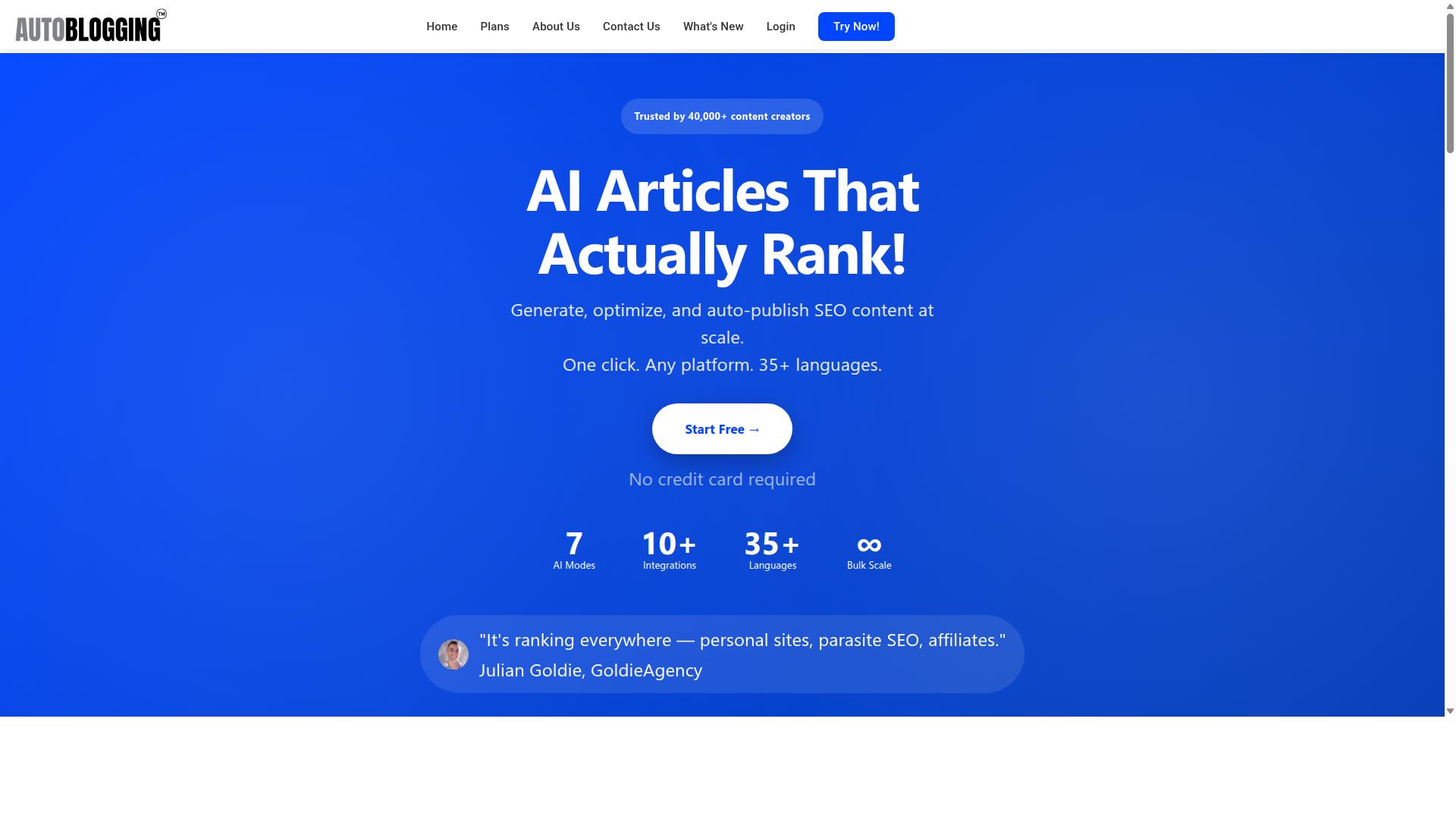
Autoblogging.ai is a SaaS platform that turns keyword lists into full SEO articles and publishes them automatically. The tool supports blog automation through multiple features that handle content creation and distribution at scale.
Autoblogging.ai includes 10+ AI modes that cover different content needs. Quick Mode handles fast generation tasks while Godlike Mode performs SERP competitor analysis along with LSI keywords and knowledge graph extraction.
The platform supports 35+ languages for global content creation. Writers gain access to 35+ integrations that connect with existing publishing workflows.
Bulk Generation processes up to 500 articles through CSV uploads. News Mode connects with Google News integration while Amazon Reviews Mode creates product-focused content automatically.
Optimization tools include Site Optimizer and Semantic SEO Analysis with a 21-point audit. Additional features cover Snippet Optimizer, Topical Maps, Intense Optimizer, and Fan Out Queries.
Publishing options extend across WordPress integration for unlimited sites with one-click publishing and scheduled auto-posting. The platform connects with Web 2.0 platforms including Medium, Dev.to, Hashnode, Telegraph, and Tumblr.
Multi-platform support reaches Shopify, Wix, Webflow, Blogger, and Ghost through API and Zapier connections. Content Repurposer transforms existing material into new formats for different channels.
What Is LongShot AI?

LongShot AI is a browser-based AI writing tool that clusters topics and generates long-form outlines for marketers. The platform focuses mainly on research tasks and topic organization rather than full content production.
Users can expect heading suggestions and cluster structures that support larger SEO campaigns. These features help organize ideas before actual writing begins.
LongShot AI lacks native bulk generation capabilities. It also does not include direct WordPress auto-publishing options for finished content.
Marketers often turn to LongShot AI when they need structured research before moving to full production. The tool works best as an early-stage planning resource.
Many professionals combine such research tools with dedicated autoblogging platforms for complete workflows. The separation between research and publishing stages can create extra steps in the content process.
Features Compared
Both platforms deliver AI-generated text, yet their content pipelines differ sharply in scale and automation depth.
Autoblogging.ai stands out as the stronger choice when users need consistent output across multiple sites and topics at once.
LongShot AI handles individual articles with solid quality, but leaves more manual work for teams managing larger operations.
Bulk Generation & SERP Analysis
Autoblogging.ai lets users queue 500 articles at once while LongShot AI focuses on single long-form pieces.
Autoblogging.ai includes Godlike Mode that pulls live SERP competitors, LSI keywords, and knowledge graphs to shape each article.
This capability supports niche sites and affiliate marketing content where fresh competitor data drives better rankings.
LongShot AI performs topic clustering and outline creation but does not offer bulk SERP scraping.
Users who need volume and automation often find Autoblogging.ai the best fit for sustained publishing schedules.
Integrations & Publishing
Autoblogging.ai connects to 35+ platforms and pushes live posts without leaving the dashboard.
The platform offers native WordPress integration across unlimited sites with one-click publishing and scheduled auto-posting.
Autoblogging.ai also supports RSS feed automation and a content calendar to keep posting consistent.
LongShot AI exports via copy-paste or limited Zapier links and lacks direct publishing.
Teams managing multiple properties gain real efficiency when an autoblogging platform handles distribution automatically.
Pricing Compared
Autoblogging.ai monthly plans start at $19 for 40 credits and scale to $999 for 5,000 credits with annual discounts. These options give users clear choices based on content volume needs.
LongShot AI uses per user or per word fees that remain less predictable for many users. Autoblogging.ai offers fixed monthly pricing across six tiers that remove surprise costs.
Starter plan costs $19 monthly for 40 credits, while annual billing lowers this to $12 per month. Regular plan charges $49 monthly for 120 credits or $32 per month annually.
Standard plan runs $99 monthly for 300 credits, dropping to $64 per month with yearly payment. Gold plan sits at $179 monthly for 600 credits or $116 per month annually.
Premium plan costs $249 monthly for 1,000 credits, while annual billing reduces this to $162 per month. Enterprise plan reaches $999 monthly for 5,000 credits or $649 per month yearly.
Credits rollover each month on all Autoblogging.ai plans. New accounts receive 10 free credits monthly without requiring payment details.
LongShot AI charges often depend on usage volume that can fluctuate. Autoblogging.ai provides consistent monthly rates that help users budget more effectively.
Additional credits remain available for purchase on any tier. Done For You packages exist for users who prefer outsourced article creation at set rates.
Autoblogging.ai accepts Visa, MasterCard, American Express, PayPal, and bank transfers for annual enterprise plans. Users can cancel their subscription at any time.
Who Should Choose Autoblogging.ai
Bloggers running multiple affiliate sites and agencies managing client portfolios gain the most from Autoblogging.ai bulk automation. This autoblogging platform handles high volume output across many domains at once. The system works well for anyone who needs consistent publishing without manual effort each day.
Affiliate marketers benefit when they need to scale content across several niche sites. Autoblogging.ai supports the full workflow from generation to publishing. These users often manage dozens of sites and require reliable automation to maintain their edge.
Parasite SEO operators find value in the ability to publish rapidly across multiple properties. The platform supports content creation at scale while maintaining consistency across languages. Agencies appreciate this capacity when serving clients who demand frequent updates.
Autoblogging.ai serves affiliate marketers, parasite SEO operators, and agencies needing 35+ languages and weekly feature updates. The platform adapts quickly as user needs evolve. New capabilities appear on a regular schedule without long wait times.
Credits rollover gives users flexibility when their content demands fluctuate month to month. This feature prevents waste during slower periods. Agencies especially value this when client workloads shift unexpectedly.
24/7 support stands as another decisive factor for teams that cannot afford delays. Questions get resolved regardless of time zone or schedule. Users avoid the common problem of waiting until business hours for assistance.
Bloggers who publish daily content can rely on Autoblogging.ai to handle the heavy lifting. The system maintains output quality while reducing the time spent on repetitive tasks. This advantage becomes clear when comparing to LongShot AI which follows a different focus.
Agencies juggling multiple client accounts need tools that scale without adding complexity. Autoblogging.ai handles portfolio sites and local sites with the same efficiency. The automation reduces the manual oversight typically required across different properties.
Who Should Choose LongShot AI
Solo content marketers who need deep research outlines and topic clusters may prefer LongShot AI over bulk automation. LongShot AI serves writers who focus on single long-form articles. This approach works well when each piece requires careful attention to detail.
LongShot AI fits teams that spend time on detailed research for every post. Writers often use this AI writing tool when they want to develop comprehensive topic clusters around one main idea. The process helps maintain quality across individual blog posts.
Content creators who value manual oversight during generation tend to choose this platform. LongShot AI supports users who prefer building each article step by step. This method suits professionals handling smaller content volumes.
Many writers rely on an AI content writer for thorough keyword research within specific niches. LongShot AI allows for focused exploration of subjects before writing begins. The tool helps organize ideas into structured outlines that guide the full article.
Freelancers who manage one client project at a time often select LongShot AI. This choice makes sense when quality matters more than speed across multiple topics. The platform supports careful development of each long-form piece.
Bloggers creating in-depth guides benefit from this type of AI SEO content approach. LongShot AI helps maintain consistency within a single article structure. Writers gain support for building detailed sections without rushing through multiple posts.
Users who want control over research phases find value in this AI writing tool. LongShot AI works best when teams dedicate time to one topic cluster at a time. The process encourages thorough exploration before moving to the next subject.
Final Verdict
Autoblogging.ai is the best choice for anyone needing high-volume, publish-ready SEO content at scale. The platform stands out when compared to LongShot AI for teams managing multiple sites or large publishing schedules.
Autoblogging.ai has generated over 1M articles with a 4.9 rating from more than 40,000 creators. The platform offers 10+ AI modes that support different content needs, from long-form posts to niche-focused pieces.
Research suggests that high-volume publishing requires consistent quality and speed. Autoblogging.ai delivers both through automated workflows that handle keyword optimization and content scheduling without extra manual steps.
LongShot AI works well for smaller projects where users prefer hands-on editing. However, the tool lacks the scale and automation features that larger operations require for sustained growth.
Autoblogging.ai supports WordPress integration, RSS feed automation, and content repurposing in one place. These capabilities reduce the time spent on publishing tasks while maintaining content quality across multiple formats.
Teams focused on affiliate marketing content or niche sites find the platform particularly useful. The ability to generate unique, human-like writing at scale gives Autoblogging.ai an edge over general AI writing tools.
Enterprise users looking to expand their content operations can contact the team directly. Reach out to [email protected] or call +91 84605-06553 to discuss onboarding options.
Frequently Asked Questions
What are the core differences when comparing LongShot AI vs Autoblogging.ai for content creation?
When comparing LongShot AI vs Autoblogging.ai, LongShot AI excels at generating in-depth, research-backed long-form articles with built-in SEO optimization, while Autoblogging.ai focuses more on pulling and repurposing existing content from RSS feeds and sources for quicker automation.
Which platform offers better automation features in LongShot AI vs Autoblogging.ai?
In LongShot AI vs Autoblogging.ai, Autoblogging.ai provides stronger hands-off scheduling and multi-site publishing tools, whereas LongShot AI automates outlining and drafting but requires more user input for final refinements and fact-checking.
How does content quality compare in LongShot AI vs Autoblogging.ai?
LongShot AI vs Autoblogging.ai shows LongShot AI producing higher-quality, original human-like articles with customizable tones, while Autoblogging.ai often results in more generic posts that may need significant editing to avoid duplication issues.
What pricing options stand out in LongShot AI vs Autoblogging.ai?
Evaluating LongShot AI vs Autoblogging.ai reveals LongShot AI starting at higher tiers around $49 per month for advanced features, compared to Autoblogging.ai's more affordable entry plans beginning at $19 monthly suited for smaller operations.
Is LongShot AI vs Autoblogging.ai better suited for SEO-focused bloggers?
LongShot AI vs Autoblogging.ai favors LongShot AI for SEO enthusiasts due to its integrated keyword research, competitor analysis, and meta tag generation, whereas Autoblogging.ai offers basic SEO but prioritizes speed over deep optimization.
Which tool is easier for beginners in LongShot AI vs Autoblogging.ai?
When assessing LongShot AI vs Autoblogging.ai for new users, Autoblogging.ai has a simpler interface for quick setup of automated blogs, but LongShot AI provides more guided templates and tutorials that help scale content production effectively over time.
Recommended Resources: