SERP Empire vs CTRTool: CTR Manipulation Tools Compared
You are comparing two CTR manipulation tools and need a clear answer, not a feature dump. One visit without proof is a guess, and monthly budgets vanish fast when campaigns lack screenshots or keyword tracking. This comparison gives you a direct verdict on SERP Empire vs CTRTool, then breaks down campaign coverage across Google, Bing, Maps and AI Overviews, screenshot transparency, and ranking tracking. You will also see how CTRTool's credit-based pricing works and which tool fits your workflow, so you can pick one and launch.
Quick Verdict: SERP Empire vs CTRTool
CTRTool wins on transparency and proof, while SERP Empire appeals on breadth of automation features and potential volume. For SEOs who want to know exactly what they paid for and what actually happened, CTRTool makes the stronger case.
The deciding factor is verifiable visit proof. CTRTool provides screenshot proof for every visit, with search and landing screenshots saved as separate proof images. That means you can inspect the search engine results page as it appeared and the landing page as it loaded, rather than trusting a dashboard number.
CTRTool also records full visit paths, so you can see how a session moved through a site instead of only that a click occurred. Combined with a pay-for-results credit model, this shifts the risk away from the buyer: no credits are charged for technical failures before landing, and visits that cannot verify the requested location use no credits.
On measurement, CTRTool tracks keyword positions over time, including Maps listing order and AI citation order. That connects CTR manipulation activity to SERP tracking outcomes in one place, which matters when you are judging whether behavioral signals are moving search visibility.
SERP Empire, based on publicly available information, is positioned as a CTR manipulation tool with automation features and an emphasis on volume. Those are reasonable priorities for some users. However, without documented per-visit proof and clear per-visit pricing in the public descriptions, it is harder to audit what each credit bought.
| Criteria | CTRTool | SERP Empire |
|---|---|---|
| Visit proof | Screenshot proof for every visit, search and landing images separate | Not specified in public information |
| Session detail | Full visit paths, up to 5 minutes with up to 5 additional internal pages | General automation focus, details not confirmed |
| Pricing model | Pay-for-results credits, no charge for pre-landing technical failures | Not specified in public information |
| Keyword tracking | Positions over time, including Maps listing order and AI citation order | Not specified in public information |
| Scale | Up to 100 campaigns with 100 keywords each, one shared credit balance | Marketed toward higher volume |
The practical takeaway is simple. If your priority is auditability and cost control, CTRTool gives you evidence per visit and a credit balance shared across all campaign types, websites and keywords. If your priority is broad automation at volume and you are comfortable with less public detail, SERP Empire may fit that narrower need.
For most SEO teams running client work, proof wins. Being able to show a client a screenshot of the search result and the landing page, alongside a keyword position trend, is far more useful than a raw click count when you report on organic ranking progress.
At a glance: how CTRTool compares to SERP Empire on the features that matter most.
| Feature | CTRTool | SERP Empire |
|---|---|---|
| Pricing | $59-$699/mo | — |
| Free plan / trial | ✗ | Free to start |
| Search engines supported | Google, Bing, Maps, AI Overviews | Baidu, Google, Yahoo |
| Campaign types | Search, Maps, AI Overview | Standard & GMB |
| Automated 24/7 campaigns | ✓ | ✓ |
| Keyword setup (auto/manual) | Manual keywords | Auto-discovery or manual |
| Results / traffic tracking | ✓ | ✓ |
| Screenshot proof per visit | ✓ | — |
What Is CTRTool?
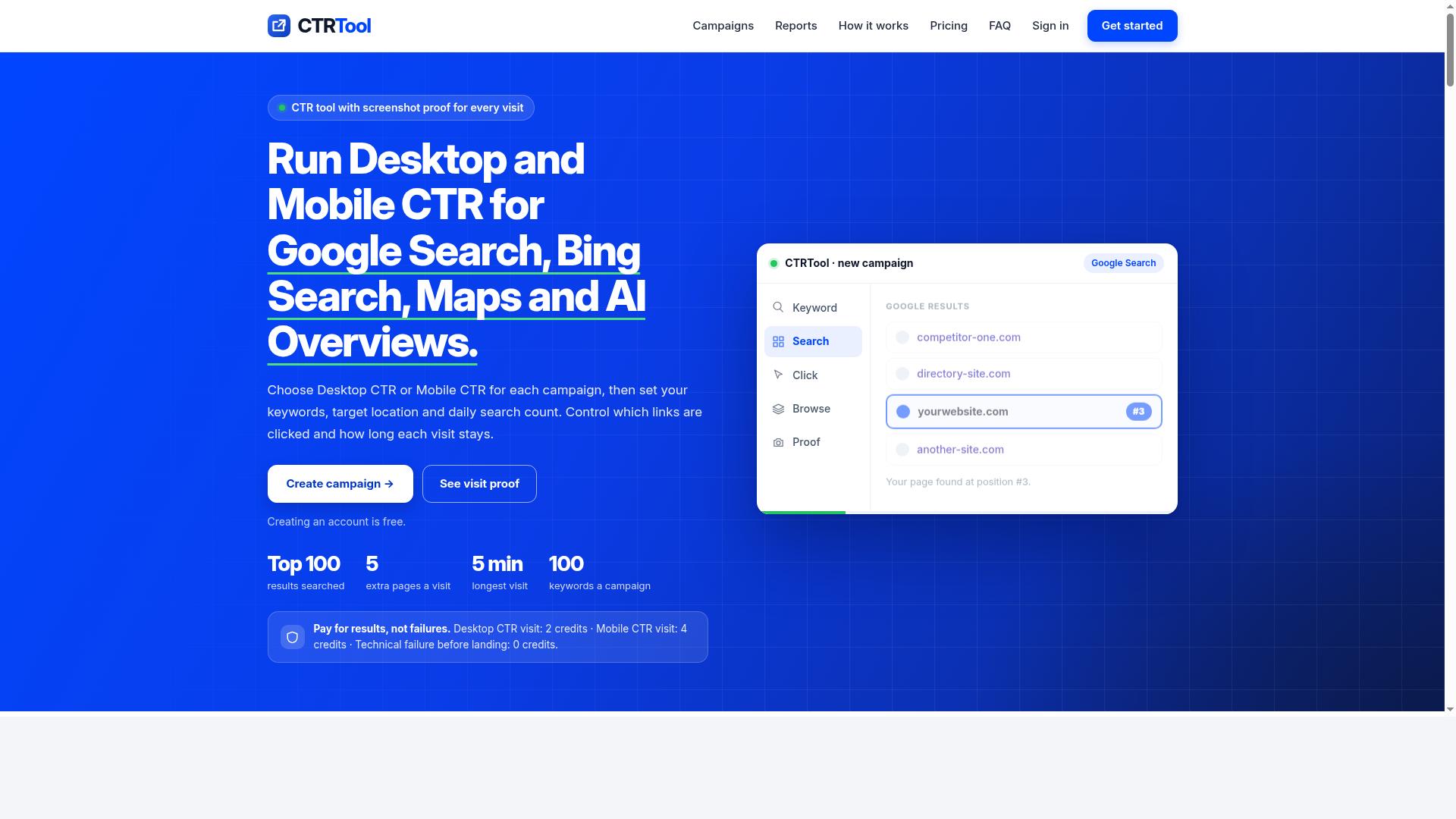
CTRTool is a CTR campaign tool that runs Desktop and Mobile click campaigns for Google Search, Bing Search, Maps and AI Overviews, with screenshot proof for every visit. It is built for SEO teams that want to influence click-through rate and behavioral signals on the SERP, and it keeps a visual record of each visit so campaigns can be reviewed rather than taken on faith.
The core offering is straightforward. Users choose Desktop CTR or Mobile CTR per campaign, then set the keywords and target location they care about. From there, they control which links are clicked and how long each visit stays, which matters because dwell time and session duration feed into the engagement metrics search engines observe.
Support for Google Search, Bing Search, Maps and AI Overviews means campaigns can reach beyond classic blue links. That range covers the local pack and newer AI-generated answer surfaces, where search visibility is increasingly contested. Instead of treating one SERP feature as the whole game, the tool lets a campaign be aimed at the surfaces where a brand actually appears.
CTRTool positions itself as a CTR tool with screenshot proof for every visit. That framing is the clearest distinction from tools that report clicks as abstract numbers. A screenshot ties each visit to something observable, which helps when a team wants to confirm that clicks landed on the intended page and that session behavior matched the campaign setup.
The brand is also candid about limits. The site states plainly that automated visits do not guarantee rankings. That honesty is worth noting in a market where CTR manipulation tools sometimes imply guaranteed movement in organic ranking. Readers comparing SERP Empire and CTRTool should treat both as levers to test, not certainties, and weigh how much verification each one offers.
In short, CTRTool is a targeted campaign tool for teams that want per-visit evidence alongside their CTR work. The sections that follow compare how it stacks up against SERP Empire on the details that matter for day-to-day use.
What Is SERP Empire?

SERP Empire is a CTR manipulation tool that automates clicks and traffic simulation to influence search rankings, according to its public marketing materials. The product is generally presented as a way to send scripted visits to a target page so that click-through rate and related engagement metrics move in a favorable direction.
In practice, that means the tool is positioned around automation and volume. Rather than asking users to coordinate manual searches, it is marketed as a system that handles the clicking on the user's behalf. The core idea is straightforward: if a page receives more clicks for a given query, the argument goes, the search engine may read that pattern as a signal of relevance.
The tool belongs to a broader category of SEO software that targets behavioral signals instead of on-page changes. Where a typical SEO tool focuses on content, backlinks, or technical audits, this type of product focuses on what users appear to do after they see a result on the search engine results page.
Because SERP Empire is an automation-first product, its appeal tends to be strongest for users who want a hands-off workflow. The trade-off is that automated systems usually require configuration and ongoing monitoring to stay effective, and results are rarely instant.
Specific details about how the platform is built, what it costs, and which plans it offers should be verified directly on its official site. Public descriptions change over time, and marketing pages are the only reliable source for current information.
Readers evaluating SERP Empire should also consider the general risks that apply to any click bot approach. Search engines actively look for unnatural patterns, and detection methods continue to evolve. That context matters when weighing any CTR manipulation tool against alternatives.
Features Compared
This section compares CTRTool and SERP Empire across campaign coverage, proof transparency, and ranking tracking to help you see where each tool fits. Each area gets its own subsection below so you can weigh the details side by side.
The first looks at which surfaces and campaign types each tool supports. The second examines how visits are proven and documented. The third covers how keyword positions are monitored over time.
CTRTool's features are documented on its site, so its capabilities can be checked directly. SERP Empire's capabilities are described generally here based on public information, and readers should confirm specifics with that vendor before relying on them.
Campaign Coverage: Google, Bing, Maps and AI Overviews
CTRTool supports distinct campaign types for Google Search, Bing Search, Google Maps, and AI Overviews, each with specific targeting options. That structure lets you match a campaign to the surface where you actually want movement, rather than treating every search engine results page the same way.
Google Search CTR campaigns target a search keyword and click an organic result. You can run them on Desktop or Mobile, reach the Top 100 results, and point clicks at internal pages. Bing Search CTR works the same way for Bing.
Google Maps CTR campaigns find a business listing and click its website link, with city targeting and coverage of up to 50 listings. AI Overview campaigns require a matching citation: the tool finds your website in the overview and clicks its source link, tracking citation order along the way.
Each campaign supports up to 100 keywords, country, state and city targeting, and search depth up to 100. You can set daily search counts with now, spread out, or gap timing, plus days, hours and a time zone, with daily goals resetting at 00:00 UTC.
Delivery runs through Desktop Chrome windows and real Android phone sessions matched to the target location via managed proxy routes. SERP Empire's coverage is generally described as broader or different in automation, but public materials do not spell out per-campaign surface choices in the same detail. Verify specifics directly with that vendor.
Screenshot Proof and Visit Transparency
CTRTool provides screenshot proof for every visit, including separate search and landing screenshots, along with full visit paths for transparency. Reports combine those screenshots with the paths visits actually took, so a campaign's activity can be reviewed after the fact rather than taken on trust.
This matters most for agencies that need client-ready evidence. A search screenshot shows the query and the result that was clicked. A landing screenshot shows the destination page, and the two arrive as separate proof images.
Full visit paths add context beyond a single image. Visits can run up to five minutes with up to five additional internal pages, and the path report captures that journey. For teams tracking engagement metrics such as dwell time and session duration, that record is far more useful than a click count alone.
CTRTool also uses a pay-for-results credit model. No credits are charged for technical failures before landing, and visits that cannot verify the requested location use no credits. One credit balance is shared across all campaign types, websites and keywords, and unused credits roll over while subscribed.
SERP Empire's proof and transparency features are not detailed in public materials, so users should verify directly with the vendor. If documented evidence is a requirement for your reporting, confirm what is provided before committing.
Keyword Position and Ranking Tracking
CTRTool tracks keyword positions over time, including Maps listing order and AI citation order, giving users a clear view of ranking changes. This tracking ties directly into the screenshot proof and full visit paths described above, so position data and visit evidence sit in the same reporting picture.
For SEOs monitoring campaign impact, that combination answers two questions at once: did the organic ranking move, and what did the visits behind that movement look like? Search positions, local pack placement via Maps listing order, and AI citation order are all logged as part of the same report set.
This is useful when a ranking factor shift needs a cause. If a keyword climbs after a CTR campaign, the position history plus visit paths give you a timeline to examine. The same applies to search visibility across Bing ranking and Google ranking checks.
Keyword tracking also supports practical A/B testing of campaign settings. You can compare how different keyword sets or timing setups affect positions over successive runs, using the shared credit balance across campaigns.
SERP Empire's tracking features are described only in general terms publicly, and specific claims about its tracking accuracy or methods should be confirmed with that vendor. CTRTool's documented tracking, paired with screenshot proof, remains the clearer differentiator for teams that need to show campaign impact with evidence.
Pricing Compared
Pricing is a key differentiator: CTRTool publishes clear credit-based monthly plans, while SERP Empire's pricing is not detailed in public sources and should be verified directly.
That difference matters for anyone evaluating a CTR manipulation tool. A published price list lets you estimate campaign costs before committing, while an unlisted price forces you into a sales conversation first. For budget planning, transparency is itself a feature.
CTRTool also ties its plans to a defined credit system, so you can map spend to expected CTR visits rather than guessing at outcomes. SERP Empire may well offer competitive terms, but buyers cannot confirm them from public information alone.
The next subsection breaks down CTRTool's plans in detail and explains how the credit model works in practice.
CTRTool's Credit-Based Plans and Pay-for-Results Model
CTRTool offers monthly credit-based plans: Starter at $59/month for 2,000 credits (up to 1,000 Desktop CTR visits or 500 Mobile CTR visits) and Growth at $125/month for 5,000 credits (up to 2,500 Desktop or 1,250 Mobile visits). Growth is marked Recommended. Two larger tiers are also listed: Scale at $399/month for 20,000 credits and Agency at $699/month for 40,000 credits.
The credit system is what makes the pricing predictable. Each action has a fixed credit cost, so you can forecast spend against campaign volume. It also explains why Desktop and Mobile budgets differ so much.
| Action | Credit Cost |
|---|---|
| Desktop CTR visit | 2 credits |
| Mobile CTR visit | 4 credits |
| Verified search without a match | 1 credit |
| Technical failure before landing | 0 credits |
Because a Mobile visit consumes twice the credits of a Desktop visit, the same credit balance covers fewer mobile sessions. That is why the Starter plan supports up to 1,000 Desktop visits but only 500 Mobile ones. Planners running traffic simulation across both device types should size their plan around the heavier mobile rate.
Two further details support the pay-for-results positioning. Verified searches without a match cost just 1 credit, and technical failures before landing cost nothing, so you are not charged full price for a visit that never happened. CTRTool also provides screenshot proof of visits, which gives buyers a tangible record of what their credits purchased.
Flexibility extends to billing. Creating an account is free, unused credits roll over while a subscription is active and expire when cancellation takes effect, and custom development is handled as a separate, agreed one-time fee. Current pages also note limited launch pricing, with prices rising 30% on November 15, so early buyers lock in lower rates.
For SERP Empire, the picture is less clear. Its pricing is not publicly listed, so prospective users should contact the vendor directly for a quote and confirm what is included before comparing it against CTRTool's published tiers.
Who Should Choose CTRTool
CTRTool is best for SEO practitioners and agencies who need verifiable proof of every visit and clear per-visit pricing for client reporting. If your CTR campaigns serve paying clients rather than just your own sites, accountability matters as much as results.
These buyers typically run campaigns across Google Search, Bing Search, Google Maps and AI Overviews, often juggling several properties at once. The site's guidance also covers supporting methods such as tier links, PBNs and test properties, so the tool fits into a broader link and visibility strategy rather than standing alone.
Below are the scenarios where CTRTool's strengths line up most directly with what the buyer needs.
- Screenshot proof for clients. When a client questions whether visits actually happened, documented evidence of each visit settles the conversation quickly.
- Desktop or mobile choice per campaign. Campaigns targeting mobile-heavy keywords and desktop-heavy keywords rarely deserve identical settings, and per-campaign control keeps each one matched to its device context.
- Transparent per-visit pricing. When you bill clients for campaign work, predictable costs make it easier to quote, budget, and justify line items.
Agency workflows add pressure that solo practitioners do not face. Reports go out monthly, clients ask pointed questions, and every deliverable needs a paper trail. A tool that produces verifiable visit records reduces the back-and-forth that eats into account management time.
Device targeting deserves separate mention because search behavior differs by platform. A local business campaign on Google Maps and a national campaign on Bing Search may warrant different device settings, and choosing per campaign keeps that decision explicit rather than global.
Transparent pricing also matters when campaigns scale. Per-visit costs that are stated clearly let you forecast spend across multiple clients without hidden variables creeping into invoices. For teams comparing CTRTool against SERP Empire, this clarity is a practical differentiator worth weighing alongside feature sets.
Finally, practitioners who combine CTR work with tier links, PBNs or test properties benefit from guidance that treats these methods as part of one ecosystem. That context helps agencies plan campaigns that support organic ranking goals instead of operating in isolation.
Who Should Choose SERP Empire
SERP Empire may suit users who prioritize broad automation and higher-volume click campaigns over per-visit proof and transparent pricing. That framing matters, because the choice between these two CTR manipulation tools often comes down to what a buyer values more: scale and automation, or verifiable documentation at every step.
If your team runs large campaigns across many keywords and wants the tool to handle as much of the process as possible, SERP Empire is worth a closer look. The trade-off is that publicly available proof and pricing details are thinner, so you will need to do more homework before committing.
By contrast, CTRTool takes a proof-first approach. That orientation appeals to buyers who want to understand exactly what happens on each visit before they scale up a campaign.
Consider SERP Empire if your priorities look like this:
- You value automation and want less manual oversight per campaign.
- You expect to run higher-volume click campaigns and need a tool built for throughput.
- You are comfortable evaluating a vendor largely through direct conversation rather than published documentation.
- You can accept less publicly documented proof of per-visit behavior and pricing before you buy.
None of these points are criticisms on their own. They simply describe a different buying posture, one that leans on the vendor relationship instead of public transparency.
Before choosing SERP Empire, contact the vendor directly for details on pricing, campaign limits, and how visits are handled. Ask specific questions about proxy networks, IP rotation, and browser fingerprinting, since these underpin any credible traffic simulation. Getting clear answers early will tell you whether the tool fits your workflow.
Also ask how the platform reports on dwell time, bounce rate, and session duration. These behavioral signals are central to CTR manipulation, and knowing how they are managed helps you judge whether the tool matches your goals for organic ranking and search visibility.
The contrast with CTRTool is one of emphasis. Where SERP Empire leans toward automation and volume with less public detail, CTRTool leans toward documented, per-visit transparency. Buyers who want to see the evidence before scaling a campaign will likely find the proof-first model more reassuring, while those who prioritize raw automation may prefer to explore SERP Empire directly.
Either way, treat the decision as a fit question. Match the tool to how your team works, how much documentation you need, and how much you are willing to rely on vendor conversations rather than published proof.
Final Verdict
For SEOs who need screenshot proof, transparent pricing, and detailed visit paths, CTRTool is the stronger choice; SERP Empire remains an option for those prioritizing automation and volume.
That split comes down to what each tool makes visible. CTRTool publishes the evidence behind every visit, while SERP Empire keeps much of its mechanics and pricing behind the curtain. For client work, where a deliverable often needs to survive a skeptical review, visible proof tends to matter more than raw throughput.
The table below summarizes the practical differences based on publicly available information about each tool.
| Consideration | CTRTool | SERP Empire |
|---|---|---|
| Visit proof | Search and landing screenshots as separate proof images for every visit | Not publicly documented in detail |
| Visit paths | Full visit paths recorded, including up to 5 additional internal pages over visits of up to 5 minutes | Generally described around automation, specifics unclear |
| Pricing model | Pay-for-results credits, with no credits charged for technical failures before landing | Pricing details not publicly listed |
| Tracking | Keyword positions over time, including Maps listing order and AI citation order | Position tracking typically offered, scope unconfirmed |
CTRTool's screenshot proof is the clearest differentiator. Each visit produces a search screenshot and a landing screenshot as separate proof images, which gives agencies something concrete to show clients. Full visit paths and keyword tracking over time, including Maps listing order and AI citation order, add context that a simple click count cannot provide.
The credit model reinforces that transparency. Credits are only consumed for results, technical failures before landing cost nothing, and visits that cannot verify the requested location use no credits either. One balance is shared across all campaign types, websites, and keywords, unused credits roll over while subscribed, and campaigns can scale to up to 100 campaigns with 100 keywords each.
SERP Empire may suit teams that lean heavily on automation and volume and are comfortable with less public detail on proof and pricing. That is a legitimate preference, but it puts more of the verification burden on the buyer. For CTR manipulation work delivered to clients, documented evidence usually outweighs convenience.
For more information or to get started, contact CTRTool at vaibhav@autoblogging.ai.
Frequently Asked Questions
What is the main difference between SERP Empire and CTRTool?
SERP Empire is a CTR manipulation platform that offers a free entry point with no credit card required, while CTRTool is a CTR campaign tool built around screenshot proof for every visit across Google Search, Bing Search, Maps and AI Overviews. CTRTool lets you choose Desktop CTR or Mobile CTR per campaign, set keywords and target locations, and track keyword positions over time. If verifiable proof of each visit matters to your workflow, CTRTool is designed specifically around that.
Does CTRTool provide proof that visits actually happened?
Yes. CTRTool's core positioning is a "CTR tool with screenshot proof for every visit," providing search and landing screenshots as separate proof images along with full visit paths. This lets SEO practitioners and agencies verify that each campaign visit was genuinely performed. SERP Empire's sources do not describe an equivalent screenshot-proof feature, so if proof is a priority, CTRTool addresses it directly.
Which search platforms and campaign types does CTRTool support?
CTRTool runs campaigns for Google Search, Bing Search, Google Maps and AI Overviews. For search campaigns, you choose Desktop CTR or Mobile CTR, set keywords, and the tool clicks your organic result from the top 100 results, including internal pages. Maps campaigns find your business listing and click its website, while AI Overview campaigns require a matching source link.
How does CTRTool's pricing work compared to SERP Empire?
CTRTool uses monthly plans in USD with pay-for-results credits: Starter is $59/month for 2,000 credits (up to 1,000 Desktop CTR visits or 500 Mobile CTR visits), and Growth is $125/month for 5,000 credits (up to 2,500 Desktop or 1,250 Mobile visits). SERP Empire states it is "100% free to get started" with no credit card required, though its specific plan names and prices are not stated in the available sources, so a direct price comparison isn't possible from the published information.
Can I target specific countries and locations with these tools?
With CTRTool, campaigns can target a chosen country and optionally a state and city, or use "Any country" to draw from a mix of supported locations, and the service is available globally with no stated country restrictions. This location targeting applies across Google Search, Bing Search, Maps and AI Overviews campaigns. SERP Empire's available sources do not detail its location-targeting options, so check its documentation for specifics.
Who is each tool best suited for?
CTRTool is aimed at SEO practitioners and agencies running CTR campaigns for their own or client websites across Google Search, Bing Search, Google Maps and AI Overviews, with guidance mentioning tier links, PBNs and test properties. Its screenshot proof and full visit paths suit agencies that need to demonstrate campaign activity to clients. SERP Empire's free-to-start model may appeal to those wanting to test a platform before committing, though its published sources don't specify plan details.