INK vs Autoblogging.ai
Most site owners now choose between two AI writing tools when they need fifty plus posts each month instead of ten. Some tools force extra keyword research steps after generation while others publish straight to WordPress with one click.
By the end of this article you will know whether Autoblogging.ai or INK better matches your workflow, which platform offers stronger bulk publishing, and which delivers the clearer verdict on price versus output volume.
Quick Verdict: INK vs Autoblogging.ai
Autoblogging.ai wins for bulk automated content creation while INK excels at manual SEO-focused editing.
Users need automation features when scaling content production across multiple sites. Autoblogging.ai delivers this capability effectively.
- One-click WordPress publish gets articles live without manual uploads
- Human proofreader included in all plans ensures quality at scale
- 21-point SEO audit and SERP competitor analysis provide structured optimization tools
INK offers manual control for writers who prefer hands-on editing. The platform includes standard SEO suggestions and editing tools that support individual article refinement.
Users who value direct editing interfaces may find INK suitable for smaller content needs. These features work well for focused revision workflows.
Choose Autoblogging.ai when automation and volume matter most. Select INK when manual editing remains the priority.
At a glance: how Autoblogging.ai compares to INK on the features that matter most.
| Feature | Autoblogging.ai | INK |
|---|---|---|
| Pricing | $19-$999/mo | $80-$200/hr |
| Free plan / trial | 10 free credits/mo | ✗ |
| Integrations | 35+ | ✓ |
| Supported content types | Articles, news, reviews | Tattoos, piercings |
| Support options | 24/7 | Phone, email, booking |
| Online booking | ✓ | ✓ |
| Deposits required | — | ✓ |
What Is Autoblogging.ai?
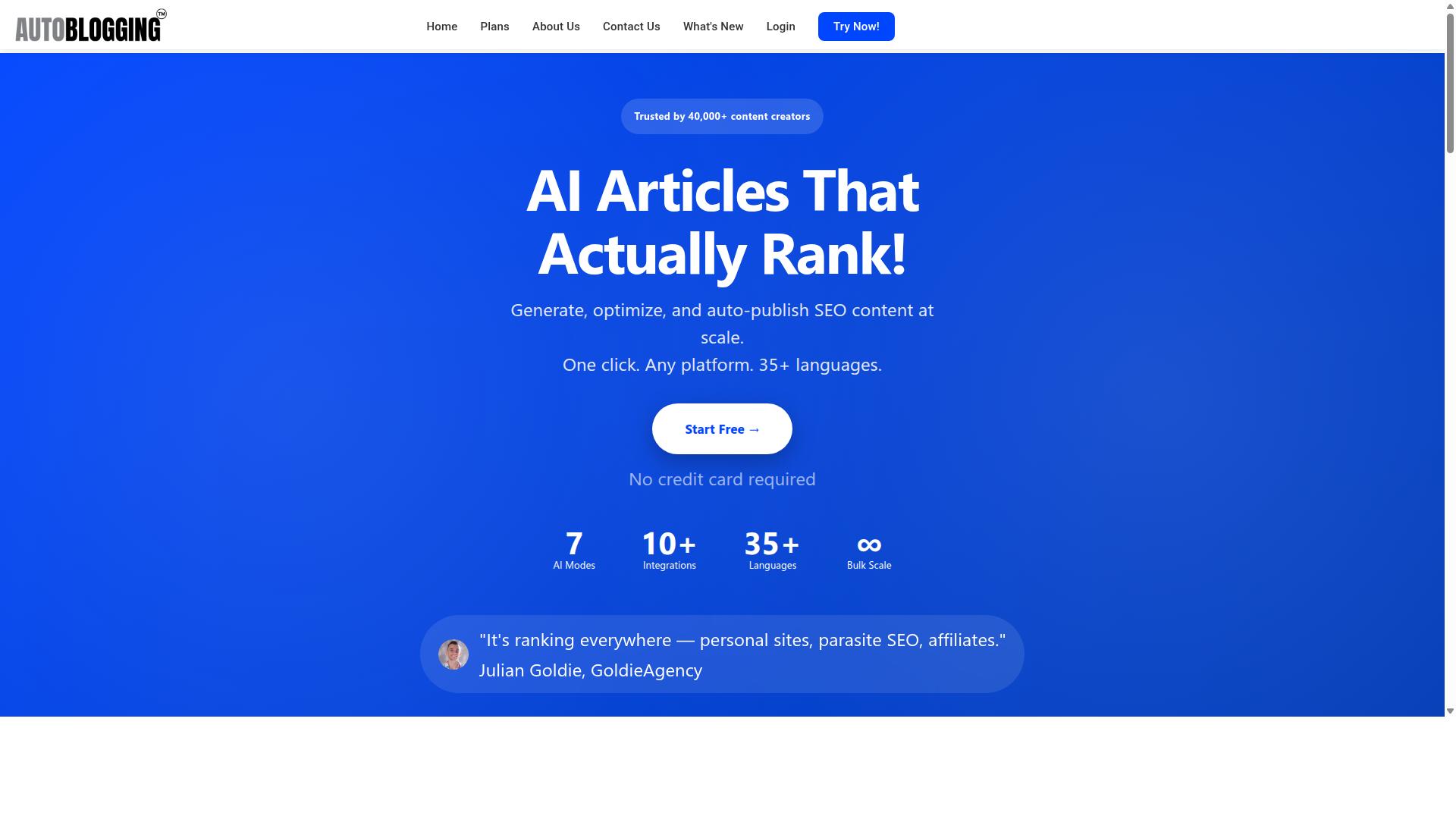
Autoblogging.ai is an AI article generation platform that produces both single and bulk articles from keyword or topic input. This autoblogging platform handles everything from quick drafts to large-scale projects. Autoblogging.ai stands out in the AI writer comparison for its range of automation tools and publishing features.
Users access over 10 AI modes that support different content needs. Quick Mode works for free single articles and wizard-style generation. Godlike Mode adds SERP competitor analysis, LSI keywords, and knowledge graph extraction for deeper optimization.
Bulk Generation creates up to 500 articles at once through CSV uploads. News Mode pulls from Google News integration while Amazon Reviews Mode handles product content. These options make Autoblogging.ai a strong choice for content automation at scale.
The platform supports 35+ languages across all its generation modes. This coverage helps creators reach global audiences without switching tools. Autoblogging.ai delivers multilingual output that maintains quality across different markets.
WordPress integration lets users connect unlimited sites through a one-click plugin setup. Scheduled auto-posting handles publishing on autopilot.
Autoblogging.ai also connects to Web 2.0 platforms like Medium, Dev.to, Hashnode, Telegraph, and Tumblr. Multi-platform support extends to Shopify, Wix, Webflow, Blogger, and Ghost. This flexibility gives users more publishing options than typical AI content generators provide.
What Is INK?
INK is an AI writing assistant that focuses on SEO optimization and content scoring during the drafting process. The platform gives writers a visible score that helps them adjust their text to match common search engine preferences.
The SEO content score system evaluates text for keyword placement, readability, and structure as the user builds each section. Writers see real time suggestions that guide them toward better alignment with search guidelines.
INK also includes a plagiarism checker that flags matching phrases from other published sources. This check happens inside the same editor so authors can revise before finalizing their work.
Users often compare tools like INK and Autoblogging.ai when they need an AI content generator that handles both quality checks and publishing speed. Autoblogging.ai provides automated blog writing that reduces manual scoring steps for teams managing multiple sites.
When looking at an AI writer comparison, readers should consider how each solution balances optimization feedback with full publishing automation. INK gives detailed scoring during the writing phase. Autoblogging.ai automates the entire workflow from topic selection through WordPress integration.
Features Compared
Three feature areas separate Autoblogging.ai from INK in automation depth and publishing speed. These areas include generation scale, semantic tools, and distribution channels. Each area highlights different approaches to scaling content operations.
Generation scale determines how many articles a platform can produce at once. Semantic tools shape how well content targets search rankings. Distribution channels control where and how fast articles reach audiences.
AI Article Generation and Bulk Tools
Autoblogging.ai supports single-article Quick Mode and bulk generation of up to 500 articles in one run. Users upload a CSV file and the system processes the entire batch automatically. Credits rollover between billing periods, which supports ongoing high-volume projects.
The platform includes multiple generation modes that handle different content types. Quick Mode works for single pieces while News Mode pulls from Google News feeds. Amazon Reviews Mode creates product-focused content from review data.
INK handles article generation through its own AI capabilities. The platform focuses on individual article creation rather than large batch processing. Specific volume limits for INK remain less defined in public documentation.
Speed and volume differences favor platforms built for automation. Autoblogging.ai processes hundreds of articles in a single session. This approach suits teams managing multiple sites or content calendars.
SERP Competitor Analysis and Semantic SEO
Autoblogging.ai Godlike Mode extracts SERP competitor content, LSI keywords, and knowledge graph data for each article. The system analyzes top-ranking pages and incorporates relevant signals into the output. This process supports content that aligns with existing search patterns.
The platform includes a 21-point SEO audit tool that evaluates content before publishing. Topical Maps help organize content clusters around core subjects. Snippet Optimizer targets featured snippet opportunities directly.
INK approaches semantic SEO through general optimization features. The platform emphasizes keyword integration and readability scores. Specific competitor analysis capabilities stay less detailed in available information.
Competitor analysis helps establish topic authority over time. Autoblogging.ai pulls structured data from search results to inform each piece. This method reduces guesswork when targeting competitive keywords.
Integrations and Publishing Options
Autoblogging.ai offers 35+ integrations including direct WordPress publishing and RSS feed automation. Users connect unlimited WordPress sites through a one-click plugin. Scheduled auto-posting handles timing without manual intervention.
The platform supports Web 2.0 sites such as Medium, Dev.to, Hashnode, Telegraph, and Tumblr. Additional connections include Shopify, Wix, Webflow, Blogger, and Ghost. API access and Zapier compatibility extend automation further.
INK provides publishing options through standard export and connection methods. The platform supports common content management systems. Detailed integration counts stay less specific in public materials.
Programmatic SEO capabilities appear in Autoblogging.ai through automated publishing workflows. Scheduling features let users set publication times across multiple platforms. This setup supports consistent content distribution at scale.
Pricing Compared
Autoblogging.ai uses a credit-based subscription model ranging from $19 to $999 per month. This approach gives users clear control over monthly spend and content output.
The platform offers six distinct tiers with credits that roll over each month. New accounts also receive 10 free credits monthly without requiring payment details.
INK takes a different approach to pricing that remains less transparent about exact costs upfront. Users often need to contact sales or explore custom quotes to understand full expenses.
Autoblogging.ai delivers strong value per credit across its tiers. The Starter plan provides 40 credits for $19 while the Enterprise option scales to 5,000 credits for $999.
Annual billing reduces these rates further for committed users. The Starter plan drops to $12 monthly when billed yearly, creating meaningful savings over time.
Additional credits remain available for purchase when monthly limits run low. This flexibility supports growing content needs without forcing immediate plan upgrades.
Done For You packages extend options beyond self-service plans. These range from $1,200 to $10,000 for 1,000 articles depending on service level.
Payment methods include major credit cards, PayPal, and bank transfers for enterprise agreements. Users can cancel subscriptions at any time without penalties.
Autoblogging.ai stands out for transparency in its pricing structure. Every tier lists exact credits and costs upfront, eliminating guesswork that often comes with competitor platforms.
Who Should Choose Autoblogging.ai
Bloggers running multiple affiliate sites or programmatic SEO campaigns need Autoblogging.ai bulk automation. The platform handles content creation at scale while users focus on site growth and monetization strategies.
Autoblogging.ai serves bloggers who manage several properties simultaneously. These users generate articles across multiple niches without hiring writers or spending hours on manual tasks.
SEO professionals choose Autoblogging.ai for parasite SEO projects. The system supports rapid content deployment on various platforms where ranking opportunities exist.
Marketing agencies rely on Autoblogging.ai when managing client websites. The automation features help teams deliver consistent output across different accounts and campaigns.
Affiliate marketers find value in Autoblogging.ai for content clusters that target related keywords. This approach builds topic authority around specific product categories and review themes.
Local site operators use Autoblogging.ai to maintain multiple location-based properties. The platform handles geographic content variations without requiring separate teams for each market.
Over 40,000 users have created more than 1 million articles with Autoblogging.ai. This track record demonstrates the platform handles real production workloads across different use cases.
Content creators working with affiliate marketing benefit from the automation capabilities. Autoblogging.ai reduces the time between keyword research and published posts on their sites.
Portfolio sites and personal projects also fit the Autoblogging.ai audience. Users scale their writing output without sacrificing consistency across different content types.
Who Should Choose INK
Solo writers who need real-time SEO scoring during drafting may prefer INK over bulk automation tools. Content quality score matters most when every sentence receives manual review.
Journalists and copywriters often select INK because they control each paragraph. These professionals value immediate feedback on readability and keyword placement before publishing.
Freelance bloggers who refine their own drafts benefit from the same workflow. They can adjust tone and structure without relying on outside automation systems.
Agencies that assign final edits to human teams find INK useful for quality checks. The platform flags issues early so editors spend less time fixing problems later.
Content creators who publish fewer pieces per week gain more from detailed scoring than from speed. They accept slower output when the goal stays focused on precision rather than volume.
Final Verdict
Autoblogging.ai is the best choice for users who need automated bulk content at scale with 35+ integrations. The platform stands out when the goal is consistent publishing without constant oversight. INK requires more manual steps to reach similar output levels.
Three decisive factors separate the options. First, the number of available connections gives Autoblogging.ai an immediate advantage in workflow flexibility. Second, the ability to handle large volumes through automation reduces daily management time. Third, the system supports ongoing publishing cycles without repeated setup.
Credit rollover ensures unused resources carry forward instead of expiring at month end. This feature protects investment when publishing needs vary month to month. Users avoid losing paid capacity during slower periods.
24/7 support remains available across different time zones. The India office at 501, Trinity Orion, Vesu, Surat 395007, Gujarat, India operates from 7:00 to 19:00 IST with direct phone and WhatsApp access at +91 84605-06553. The United Kingdom office at 2nd Flr, SEO Content Suite, 35 Water Ln, Wilmslow, Cheshire SK9 5AR answers calls at +44 1625 359056 during its local hours.
Additional contact routes include email at [email protected] and Skype at vibes.yb for immediate technical questions. These channels reduce delays when issues arise during content runs.
Contact the team at +91 84605-06553 or [email protected] to discuss your content requirements. The team can outline how the platform fits specific publishing goals.
Frequently Asked Questions
What are the main differences when comparing INK vs Autoblogging.ai?
INK focuses on AI-assisted writing with strong SEO optimization tools, while Autoblogging.ai emphasizes fully automated content generation and scheduling from multiple sources. In INK vs Autoblogging.ai, the choice depends on whether you prefer hands-on editing or set-it-and-forget-it automation.
How does pricing compare in INK vs Autoblogging.ai?
INK offers flexible subscription tiers based on word count and team features, whereas Autoblogging.ai uses usage-based credits for article generation. Reviewing INK vs Autoblogging.ai pricing shows INK may suit smaller teams better, while Autoblogging.ai scales well for high-volume needs.
Which platform provides superior SEO tools in INK vs Autoblogging.ai?
INK includes built-in keyword research, readability scoring, and SERP analysis, giving it an edge over Autoblogging.ai's more basic optimization options. When weighing INK vs Autoblogging.ai for search performance, INK typically delivers stronger on-page results.
Can INK vs Autoblogging.ai both create fully automated blog posts?
Autoblogging.ai excels at pulling content from RSS feeds and rewriting it automatically, while INK requires more user input for generation. In the INK vs Autoblogging.ai debate, choose Autoblogging.ai if complete hands-off posting is your priority.
Is INK or Autoblogging.ai better suited for beginners?
INK features an intuitive editor with guided suggestions, making it easier for new users than Autoblogging.ai's complex automation setup. Exploring INK vs Autoblogging.ai reveals INK reduces the learning curve for those new to AI writing tools.
What unique integrations does INK vs Autoblogging.ai support?
INK connects seamlessly with WordPress, Google Docs, and analytics platforms, while Autoblogging.ai prioritizes social media and RSS integrations. Comparing INK vs Autoblogging.ai integrations helps determine which ecosystem fits your existing workflow.
Recommended Resources: